How do cells know when they are the right size to divide?
The Miller Lab at Providence College investigates one of the most fundamental questions in cell biology: how cells coordinate growth with cell division to maintain the proper size. Using fission yeast as a model system, we combine quantitative microscopy, genetics, cell biology, and other interdisciplinary approaches to uncover the mechanisms that regulate cell size.
Featured Publication
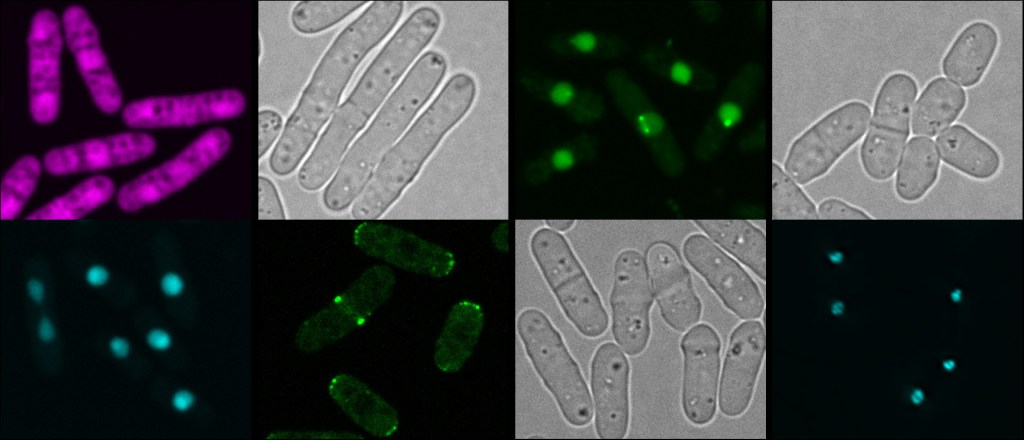
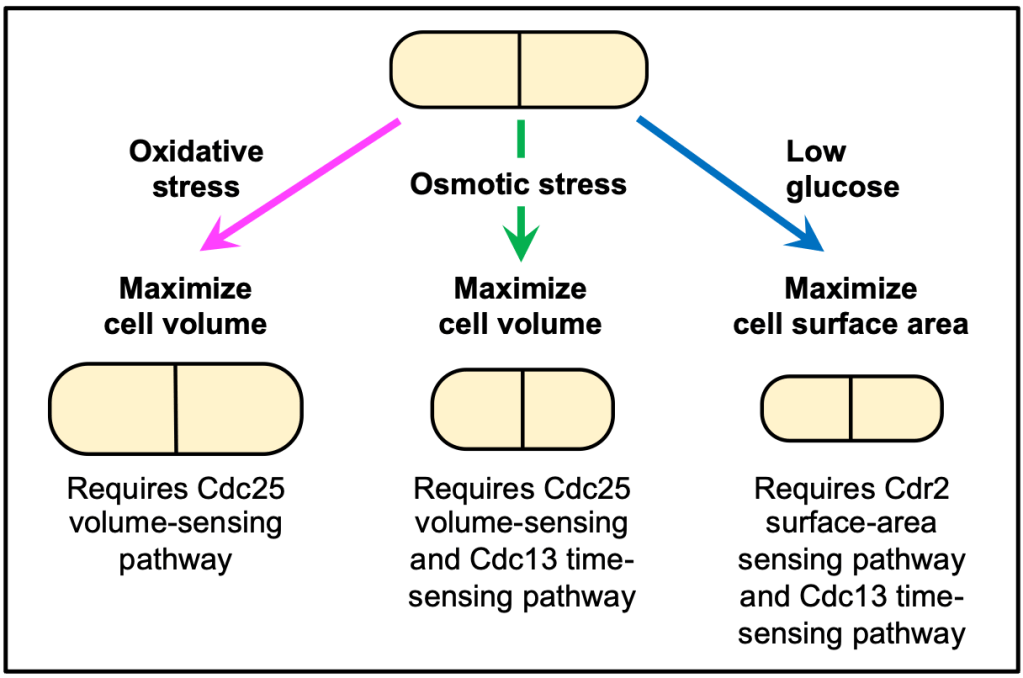
Our latest study reveals that cells actively remodel their cell size control networks in response to environmental conditions. Using quantitative microscopy in fission yeast, we found that osmotic, oxidative, and low glucose conditions each produce distinct cell geometries by differentially engaging surface area-, volume-, and time-dependent pathways that regulate cell division. These findings support that cell size control is a dynamic, environmentally responsive network rather than a fixed regulatory system.
This work was made possible by the outstanding contributions of Providence College undergraduate researchers, whose dedication and curiosity were central to the project.
Published in Molecular Biology of the Cell (2026) Read the full paper here
Research Support
The Miller Lab is grateful for support from


